Description
AngioDynamics NanoKnife Electrostimulation
Advanced Irreversible Electroporation System for Precision Tumor Ablation
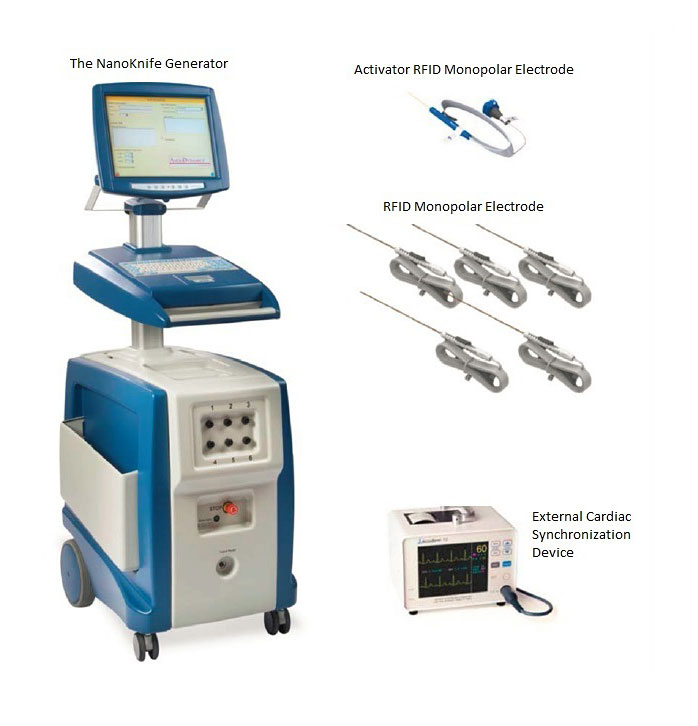
The AngioDynamics NanoKnife is an innovative soft-tissue ablation system that uses Irreversible Electroporation (IRE) technology to destroy cancerous cells with precision and minimal collateral damage. Unlike heat-based ablation systems, the NanoKnife uses powerful, high-voltage electrical pulses to permanently disrupt cell membranes while preserving critical structures such as blood vessels, ducts, and connective tissue. This makes it an essential tool for treating tumors located near sensitive anatomy.
Developed for use in general surgery, interventional oncology, and minimally invasive procedures, the NanoKnife system offers highly targeted ablation with predictable, uniform results—expanding treatment possibilities for patients with unresectable or difficult-to-reach tumors.
Key Features
-
Irreversible Electroporation (IRE) Technology
Utilizes electric pulses to create nanoscale pores in cell membranes, leading to natural cell death without heat-induced damage. -
Non-Thermal Tissue Ablation
Protects vital structures, making it ideal for tumors near nerves, vessels, and bile ducts. -
Precision Electrode Placement
Multiple needle electrodes allow customizable geometry and accurate treatment zones based on tumor size and shape. -
Real-Time Monitoring & Control
Advanced software tracks pulse delivery, impedance, and system performance for safe and reliable procedures. -
Minimally Invasive
Reduced trauma, faster recovery, and improved patient tolerance compared to traditional ablation methods.
Clinical Applications
-
Liver tumors (primary and metastatic)
-
Pancreatic lesions
-
Prostate tumor ablation
-
Soft-tissue oncology
-
Ablation near critical structures that limit thermal technologies
Key Benefits
1. Non-Thermal Tissue Ablation
Uses Irreversible Electroporation (IRE) to destroy targeted cells without relying on heat or cold, reducing the risk of thermal injury to surrounding tissues.
2. Preserves Critical Structures
Safely ablates tissue while preserving collagen-based structures such as blood vessels, bile ducts, nerves, and the gastrointestinal tract—ideal for tumors in challenging anatomical locations.
3. Precise, Controlled Ablation Zones
Multi-electrode configuration enables clinicians to sculpt highly customized ablation zones, even for irregularly shaped or difficult-to-reach lesions.
4. Real-Time Imaging Guidance
Compatible with ultrasound, CT, and MRI guidance, allowing accurate electrode placement and continuous procedural visualization.
5. Minimally Invasive Treatment
Requires only percutaneous or laparoscopic electrode insertion, resulting in reduced surgical trauma, quicker recovery, and improved patient comfort.
6. Reduced Risk of Collateral Damage
Non-thermal mechanism helps minimize unintended damage to healthy tissue, making it suitable for anatomically sensitive or high-risk cases.
7. Effective for Complex Tumor Locations
Well-suited for soft tissue ablation in organs such as the pancreas, liver, kidney, lung, and prostate—especially when other ablation methods pose safety challenges.
8. Advanced Safety Monitoring
Real-time impedance and pulse-quality monitoring ensure consistent energy delivery and provide automatic system shutdown if irregularities occur.
9. Consistent, Predictable Results
Automated pulse calculations and ECG-synchronization technology support stable and reproducible procedural outcomes.
10. Enhances Organ Preservation
Allows clinicians to treat lesions without sacrificing major anatomical structures, supporting better long-term organ function and quality of life.
Technical Specifications – AngioDynamics NanoKnife
Technology
-
Irreversible Electroporation (IRE)
-
Non-thermal ablation using high-voltage, low-energy electrical pulses
-
Multi-electrode needle placement for 3D ablation geometry
Energy Delivery
-
Pulse type: Ultra–short electrical pulses
-
Pulse length: 70–100 microseconds
-
Pulse frequency: Adjustable
-
Pulse count: Typically 90–100 pulses per treatment cycle
-
Voltage range: 1,000 – 3,000 volts (user-adjustable based on electrode spacing)
Electrode System
-
Single-use IRE electrode needles
-
Adjustable exposure length (1–4 cm depending on model)
-
Up to 6 electrodes for complex lesion shapes
-
Needle spacing: Typically 1.5 – 3.0 cm
Ablation Zone
-
Customizable ablation zone determined by electrode configuration
-
Suitable for irregularly shaped soft tissue lesions
-
Preserves blood vessels, ducts, nerves, and collagen structures
Imaging Compatibility
-
Real-time imaging guidance:
-
Ultrasound
-
CT
-
MRI (certain models and environments)
-
-
Synchronous visualization for accurate electrode placement
User Interface
-
10–12″ touchscreen display
-
Automated pulse parameter calculator
-
Safety interlocks and real-time monitoring
-
Graphical electrode-placement planning system
Safety & Monitoring
-
Impedance monitoring and pulse quality analysis
-
Automatic shutdown on abnormal electrical feedback
-
ECG synchronization (for cardiac protection during abdominal procedures)
-
Integrated patient return electrodes (depending on system model)
System Requirements
-
Power supply: 100–240V AC, 50/60Hz
-
Power consumption: Approx. 500–700 W
-
Operating environment: Standard surgical or interventional radiology suite
Physical Specifications
-
Console dimensions: Approx. 45 × 35 × 60 cm
-
Weight: 25–35 kg (model-dependent)
-
Mobile cart configuration available
Clinical Applications
-
Soft tissue ablation in:
-
Liver
-
Pancreas
-
Kidney
-
Lung
-
Prostate
-
-
Ideal for lesions near critical structures where thermal ablation is unsafe
Why Choose the AngioDynamics NanoKnife?
The NanoKnife Electroporation System provides clinicians with a unique, next-generation ablation platform that expands treatment options for challenging tumors. Its non-thermal IRE approach delivers unparalleled precision, making it a powerful solution for modern interventional oncology and advanced surgical care.
Reviews
There are no reviews yet.